


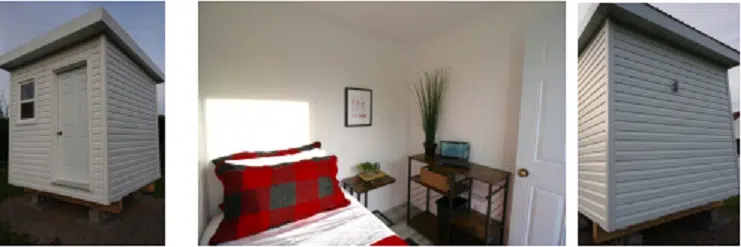
Twenty tiny homes for high-acuity individuals who are homeless or with addiction issues will be built on a farm run by the Humanity Project.
Moncton City Council unanimously approved $310,000 to support the Josh Project (Just Organization Serving Humanity Project).
Phase one features custom-built tiny house dwellings for immediate emergency use. They will provide emergency housing for up to 20 individuals to get those experiencing homelessness off the street immediately.
These tiny house dwellings will also help take the strain off city-area shelters now and for the coming winter.
The request for funds from Moncton will cover infrastructure costs for phase one for 20 emergency units of $13,260 for site prep and $295,820 for the custom-built shelters (furnishings and labour included).
The houses are 8’ x 8’ with a lockable door, a bed, a desk, a closet, a mini-fridge, a hamper and a mini-split heat/AC unit. Each unit will have its own power panel and be hooked up to existing utilities for heat and lights with approval from the local fire and safety departments.
Individuals residing at the Josh Project property who use these tiny house dwellings will not live there permanently. They will eventually graduate to one of the other housing options as they are able and as the subsequent phases of the Josh Project are completed.
Phase one is expected to get underway right away and is expected to receive its first occupants by Nov. 1.
Humanity Project Founder Charles Burrell says, “This is a project based on years and years and years of talking to people, listening to them and helping them with their needs and understanding that there are people out there who want to better themselves. I don’t have people asking to go to the farm anymore, I have them begging to go to the farm.”
Funds are contingent upon the province of New Brunswick’s support of operational costs and that the Humanity Project comply with all zoning, and building and fire code regulations required for their location.
The provincial government has also committed up to $1.2 million to support the staff and overhead costs of Phase 1 of the project.
Burrell adds, “If we really want to see a solution and we want to lower our (homeless) numbers, we need to help people. It will lower crime and the biggest thing it will do is inspire other people in the community who are struggling and hurting to get the help they need because they saw someone else that got help.”
The Josh Project is located on a working farm in Little River, Albert County, near Elgin. The farm was purchased in September 2020 by an anonymous donor who donated it to The Humanity Project.
Since taking ownership, The Humanity Project has expanded the garden area and added livestock. They use the vegetables and the meat they raise to help offset food costs for those onsite at The Josh Project and for the Hot Meal Program in Moncton
“There’s a lot of people out there who we are going to lose if we don’t give them the help they need. They deserve to get back to their families and see their children and see their parents again,” Burrell concluded.

 Follow