


Five projects considered of national importance are before a new federal office for consideration.
They include two copper mines in western Canada, a natural gas pipeline and the expansion of Montreal’s Port.
The Major Projects Office (MPO) was established in August to help fast-track projects deemed nation-building and structure financing.
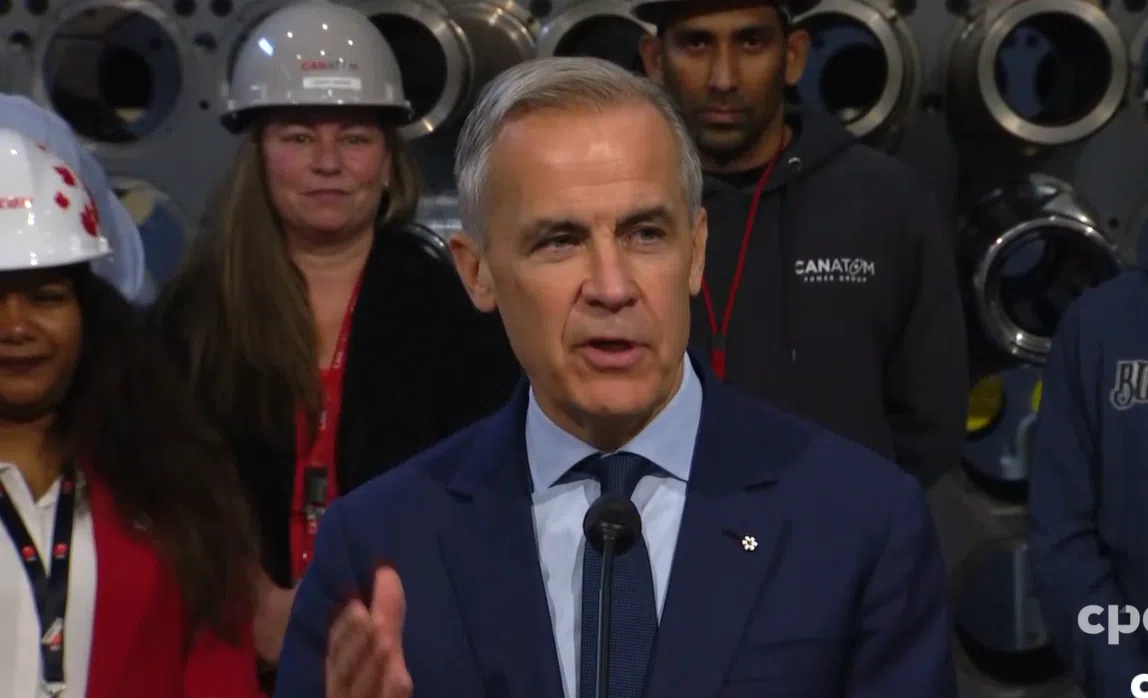
Prime Minister Mark Carney says it will help Canada take control of its economic future.
“We’re having discussions. We’re sequencing the discussions with the province of Ontario and all the provinces on big infrastructure projects that unlock, that do multiple things,” says Carney.
“They unlock big economic benefits for Canada. Ideally, they connect different parts of the country in ways that create even further opportunities.”
Carney says the projects also align with the government’s climate objectives and have meaningful Indigenous participation.
He adds that his government has been setting the stage for the province to present its projects and receive federal support.
“We started by creating the right conditions to get big things built faster. Over the six months, the new government of Canada has focused on this mission, first, the conditions that will move big projects more quickly. Because for too long, the construction of major infrastructure projects has been stalled by an arduous, inefficient federal approval processes, uncertainty, red tape, duplication and complicated review processes.”
Carney says a second round of projects to be identified as nation-building is to be revealed by the middle of November.
The projects under review are;
LNG Canada Phase 2, Kitimat, British Columbia: This project will double LNG Canada’s production of liquefied natural gas, making it the second-largest facility of its kind in the world. It is expected to attract significant private-sector capital to Canada, contribute to our GDP growth, and support jobs and economic growth in local communities. It will diversify our trading partners and meet increasing global demand for secure, low-carbon energy with Canadian LNG, contributing to worldwide energy security by increasing the supply of available natural gas for Asian and European partners. Leveraging Canada’s sustainable advantage, emissions are projected to be 35% lower than the world’s best-performing LNG facilities and 60% lower than the global average.
Darlington New Nuclear Project, Bowmanville, Ontario: This project will make Canada the first G7 country to have an operational small modular reactor (SMR), accelerating the commercialization of a key technology that could support Canadian and global clean energy needs while driving $500 million annually into Ontario’s nuclear supply chain. Once complete, Darlington’s first of four planned SMR units will provide reliable, affordable, clean power to 300,000 homes, while sustaining 3,700 jobs annually, including 18,000 during construction, over the next 65 years. The project has the potential to position Canada as a global leader in the deployment of SMR technology for use across the country and worldwide.
Contrecœur Terminal Container Project, Contrecœur, Québec: This project will expand the Port of Montréal’s capacity by approximately 60%, to give Eastern Canada the trading infrastructure it needs to keep goods moving, meet growing demand, and diversify trade routes. It will strengthen supply chains, create thousands of jobs, and generate approximately $140 million annually in local and national economic benefits across Québec and Canada.
McIlvenna Bay Foran Copper Mine Project, East-Central Saskatchewan: Situated in one of Canada’s richest mineral belts and working in close collaboration with the Peter Ballantyne Cree Nation, this project will supply copper and zinc to strengthen Canada’s position as a global supplier of critical minerals for clean energy, advanced manufacturing, and modern infrastructure. It will create 400 jobs, boost local economies in Saskatchewan and Quebec, where the copper will be smelted, and is expected to be the first net-zero copper project in Canada.
Red Chris Mine expansion, Northwest British Columbia: This major expansion project will extend the lifespan of the mine by over a decade, increase Canada’s annual copper production by over 15%, employ about 1,500 workers during operations, with a peak of approximately 1,800 workers during construction, and reduce greenhouse gas emissions by over 70% when operational. Working in close collaboration with the Tahltan Nation, it is an important step in reconciliation and further developing the potential of Northern British Columbia and will strengthen Canada’s role as a reliable supplier of copper and other resources essential for global manufacturing and clean energy technologies. This mine is part of the proposed Northwest Critical Conservation Corridor. This corridor is being moved to the MPO for consideration, as it presents opportunities for critical minerals development, clean power transmission, Indigenous project leadership, and a potential new conservation area the size of Greece.